
Lynn Previous Record Sources
A backward address trail needs sources that cover different eras and different facts. Start with the source closest to the period in question, then carry the street string, legal description, and year into the next source. Lynn parcel tools provide current context. The Southern Essex Registry supplies recorded land instruments. Historical directories and newspapers add dated published or reported references. None of these sources alone establishes every prior household, and the table makes their different roles clear.
| Source | Years it covers | Custodian or route | What it can show |
|---|---|---|---|
| Southern Essex deed index and images | 1640 to present | Southern Essex Registry of Deeds | Recorded parties, instrument dates, book/page, and legal description |
| Lynn municipal directories | 1832 to 1980, with gaps | Massachusetts State Library inventory | A published name and address in a specific edition |
| Lynn suburban directories | Selected years, 1897 to 1998 | Massachusetts State Library inventory | Another dated directory series for comparison |
| Daily Evening Item archive | 1877 to 1949 | Digital newspaper archive | Page-dated reporting about a name, street, sale, fire, or event |
| Lynn Sanborn maps | 1893 map set | Library of Congress | Building footprint, use, and adjacent-street context |
| SmartGov parcel documents | Historical start not verified | Lynn ISD portal and Room 401 computers | A public permit or document event tied to a parcel |
Recorded owner, published listing, and occupancy are different claims. A Registry instrument names parties to a recorded transaction, while an assessor row shows tax and parcel context. A directory is a published listing. Historical occupancy needs a source that actually places a household at the address, such as a dated directory or an available census schedule, and even then the date and source boundary must remain visible.
Lynn Address Record Strings
The backward address search begins by normalizing the address, not by guessing a name. Preserve the house number, directional, suffix, unit, and any older street spelling. The research recommends testing the address in its USPS form, the Lynn AxisGIS or Patriot form, the Registry's street or name mode, and an historical directory or newspaper form. A building name, an abbreviated suffix, a legal lot description, or a postal zone can all appear where a modern street string is expected.
Use the city-linked Lynn Assessors property-data page to reach the current street list, Patriot Properties, and AxisGIS. Record the displayed parcel identifier, location, owner context, source date, and book/page if present. AxisGIS ownership refreshes weekly on Monday mornings, so a source access date matters. The result is a starting point for a deed search, not proof that a named person occupied the address.
When the first form returns nothing, test one nearby directory year, a street suffix variation, and a surname-only Registry search where the interface permits it. Keep each failed attempt with its spelling and date window. That small negative-result audit is safer than silently replacing an older street form with a modern one.
Trace Lynn Previous Owners
The Southern Essex Registry of Deeds is the authoritative land-record route for Lynn. Its records run from 1640 to the present, and the Registry says images and records can be viewed, downloaded, or printed online or in person without charge. The main office is in Beverly, with a Salem satellite. The online index is a route into the instrument image, not a substitute for it. Read the image and legal description before treating two familiar street names as the same property.
The Registry home page identifies the search routes and its current office information.
The Registry image is a starting surface for a dated land-record search. The result that matters is the linked instrument and its legal description, not a bare name match.
- Use the parcel source to capture the present street string, parcel context, and any book/page lead.
- Find the most recent recorded transfer for that property in the Registry index and open its image.
- Save the grantee, grantor, instrument date, recording date if shown, and legal description.
- Search the earlier party in the role needed to find that party's acquisition, then repeat the process backward.
- Flag an estate, trust, corporation, personal representative, plan, or description change as a branch that needs its own source check.
Lynn Deed Record Fields
The classic Registry search gives a reproducible way to narrow a prior-record trail. Its name form accepts a start and end date, last or business name, first name, Like or Exact matching, and Owner, Grantor, Grantee, or Both party roles. The street form uses a date range, street and town, plus document number. Street search coverage is limited, so it should not be mistaken for a complete historical deed search. The Registry announced a new search module in April 2026 while retaining classic search under Searches, making it important to record which interface was used.
The Southern Essex classic name-search form shows the date, name, match, and party-role controls used to narrow an instrument search.
Preserve the selected role and date window with the result. Those settings explain why a name was returned and help a later researcher reproduce or correct the search.
| Party role | Grantor is the party conveying an interest; grantee is the party receiving it. |
|---|---|
| Instrument type | Identifies the kind of recorded document, such as a deed, plan, mortgage, or discharge. |
| Document and recording dates | Keep both when shown. They can be different dates. |
| Book/page or document number | A stable bridge from an index result to the image and to related instruments. |
| Legal description | The property wording within the instrument, often more durable than a street address. |
| Image status | Note a missing page, redaction, or unavailable image instead of filling the gap. |
- Chain of title
- A sequence of recorded transfers assembled from instruments and their property descriptions.
- Grantor and grantee
- The conveying and receiving parties named in an instrument. Their roles can change from one transfer to the next.
- Legal description
- The instrument's property description, used to test whether older wording refers to the same parcel.
Lynn Records Three Clocks
Every prior-address result has at least three useful dates. The event date marks what happened. The recording or publication date marks when an instrument, directory, or newspaper page entered the source. The web update or access date marks when a current interface displayed it. A deed can be signed before recording; an assessor value can belong to a fiscal year; and a directory is tied to its publication year. Mixing those clocks can create a false sequence of past households.
- Write the event or transaction date exactly as the source displays it.
- Write the recording or publication date on a separate line.
- Add the portal refresh or source access date without substituting it for either historical date.
A clear timeline can read: source date, name as displayed, address or legal description, record type, link or citation, and confidence note. Mark an inference as an inference. This simple practice makes it clear whether a past-resident lead comes from a recorded transfer, a published address, or a report about an event.
Lynn Address Records After 1889
The 1889 downtown fire is a local reason to be careful with any Lynn address trail. The city planning history says the November fire began in Mower's Building on Almont Street, destroyed 31 downtown acres and 384 buildings, and displaced 150 households. A street number, surrounding structure, or institutional reference may change across the period. A post-fire difference should be tested through an earlier and later directory, fire-era news coverage, a map sheet, and a surviving deed or legal description.
The 1887 Lynn Directory scan is a useful pre-fire published reference point.
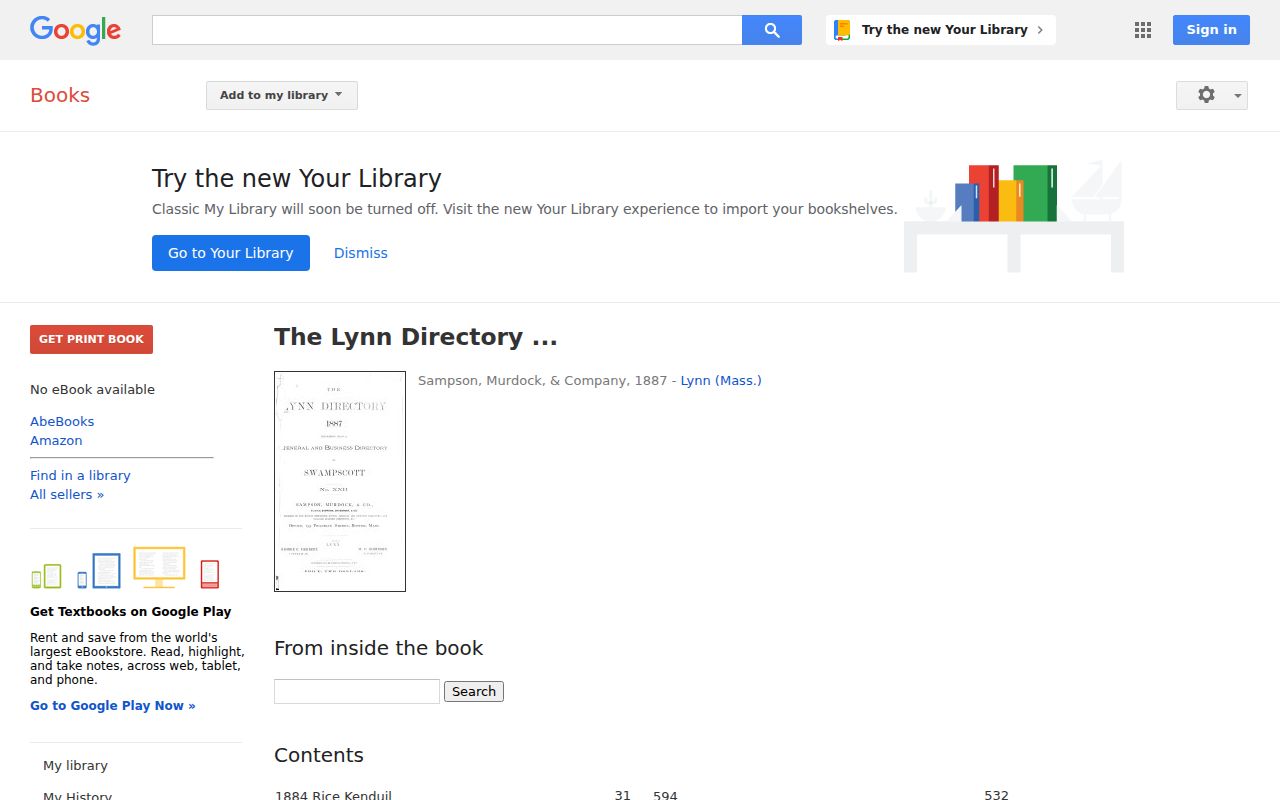
The scan can preserve the spelling and address vocabulary used before the fire. It cannot, by itself, prove a later household connection or recreate a lost building.
The 1893 Lynn Sanborn map record covers 108 sheets and can help anchor a street to cross streets and a building footprint. Pair it with a Daily Evening Item page for dated reporting. Both add context to an address sequence without becoming a list of people.
Lynn Directory and Census Pairing
Directories and census schedules answer related but different questions. The State Library inventory identifies Lynn municipal directories from 1832 through 1980 and selected suburban volumes through 1998. A directory can supply the year, spelling, and published street form that make an available census search more precise. The census schedule should keep its own date and enumeration details. Neither should be rewritten to match the other when the records differ.
- Choose the nearest Lynn directory year and transcribe the name and address as printed.
- Check an earlier and later volume for a move, a spelling variant, or a changed household clue.
- Pair the dated directory reference with the relevant available census schedule, keeping the two citations separate.
- Use a newspaper, vital citation, probate file, or recorded instrument only to test a specific gap in the timeline.
The historical volumes themselves are described on the Lynn city directory page. Here, the point is the backward sequence for one address: each new name must be tied to the correct year and source category before it becomes part of a past-household trail.
Lynn Maps, News, and Records
Maps, news, and permit records help explain a gap without taking the place of a resident record. The Sanborn sheets are historical building and block evidence. The Daily Evening Item archive has people, places, events, and date or decade browsing for 1877 through 1949. Its search result should be saved as a page and date citation. A report may identify an event connected to an address, but it does not automatically establish that every named person lived there.
Lynn SmartGov is the city route for applications, parcel search, documents, reports, and payments. It can reveal a public permit or document tied to a parcel. The research did not verify a historical archive start date, so treat an absent search result as a portal limitation rather than evidence that no older city document exists. Lynn ISD also provides two public computers in Room 401 for the SmartGov route.
For city-held material not exposed in the ordinary portal, the Lynn public-records request process is the narrow fallback. Name the department, date range, and document type, and ask for electronic delivery. A request is not a route around protected information or a substitute for the Registry's normal land-record search.
Lynn Address Record Boundaries
Past-resident research has firm limits. The absence of a name in a portal, directory, or map is not proof that the person never lived at the address. Lynn's historical sources have damaged or transferred material, index limits, changing street forms, and uneven scan coverage. Protected-address and confidential-record rules can also create intentional gaps. Preserve a no-result as a dated search note, then try the next relevant custodian or a nearby year.
Lawful use. Use Lynn previous-resident records for family history, estate research, property history, or personal curiosity. Do not use a dated address trail to stalk, harass, or track a living person.
The strongest account distinguishes the source language throughout: recorded owner for a deed or parcel context, published listing for a directory page, reported event for a newspaper item, and occupancy only where the source expressly supports it. That distinction protects both the reader and the historical record from an overstated conclusion.