
Lynn City Directory Holdings
The Massachusetts State Library inventory is the best starting point for Lynn research because it identifies the years the library holds, rather than suggesting an unbroken run. Its Lynn entries begin in 1832 and continue through 1980, with especially dense coverage from the late nineteenth century through 1946. A separate suburban-directory list reaches selected later years, including 1998. Some entries carry holding marks, so the inventory is a locator rather than proof that every volume is available for immediate use.
| Directory collection | Years noted | Custodian or scan | How to use it |
|---|---|---|---|
| State Library Lynn municipal directories | 1832 to 1980, with gaps | Massachusetts State Library | Check the inventory, then confirm Special Collections access |
| Lynn suburban directories | 1897 to 1998, selected years | Massachusetts State Library | Use as a separate series, not as a replacement for the municipal shelf |
| The Lynn Directory scan | 1867 | Google Books | Free page-image search and review |
| The Lynn Directory scan | 1887 | Google Books | Free page-image search and review |
Begin with the closest known year, then test a preceding and following volume. The historical shelf also includes selected voting-list years, but those are a different record type with different access rules. A directory gives a published snapshot. It should never be treated as a present-day roll or a complete account of every person connected to an address.
Lynn Directory Access Routes
Online scans are useful when the desired year is available, but the practical route for a missing year is often a library or archive. Lynn Public Library describes a reference collection with an emphasis on Lynn history and genealogy. The State Library inventory can point a researcher to a volume or microform run, while the library reference desk and Special Collections can clarify the access notation. For family papers, photographs, or institutional context that sits outside a directory, the Lynn Museum and Historical Society research service is a request-based option rather than a searchable resident index.
Lynn City Clerk genealogy and research instructions show the local request route for record questions that may accompany a directory trail.
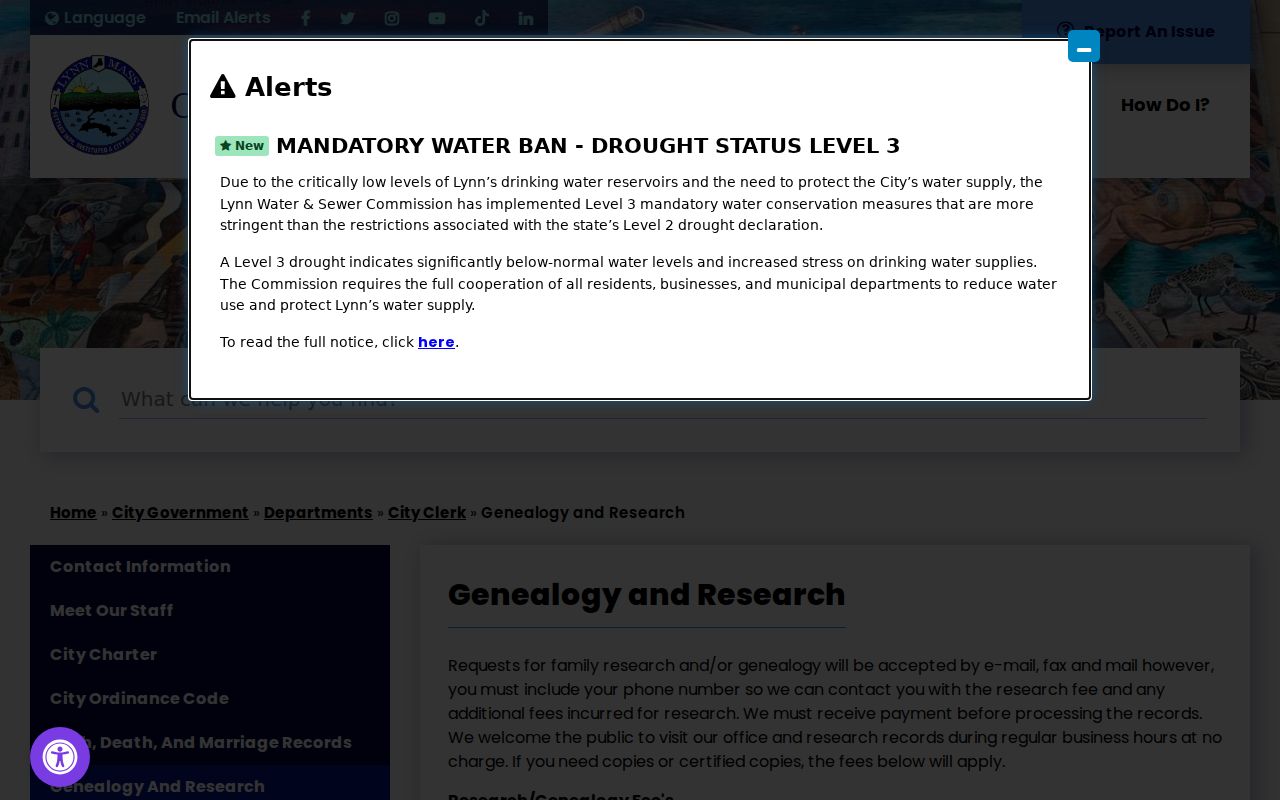
The Clerk route is useful when a dated listing leads to a record the office can lawfully provide. It does not convert a directory entry into a certificate or fill gaps in the historical shelf. Keep the directory page, request details, and returned record separate in a research log.
Access channels matter when a scan search fails. Contact the custodian with the person name, approximate publication year, and town. If a particular volume cannot be consulted online, ask whether it is available in print, microform, a reading room, or through a research request. Note: Holding marks in the State Library inventory can signal a special handling or access condition, so availability should be confirmed before relying on a trip.
Lynn Digitized Directory Scans
The digitized 1867 Lynn Directory is an early, concrete example of the material a historical directory can contain. Its scan includes names alongside city institutions, business material, physicians, courts, and Pine Grove Cemetery references. Search may find a surname quickly, but a result should be checked on the page image and against nearby entries. Page context can reveal a spelling convention, a street sequence, or a section heading that a text result does not carry.
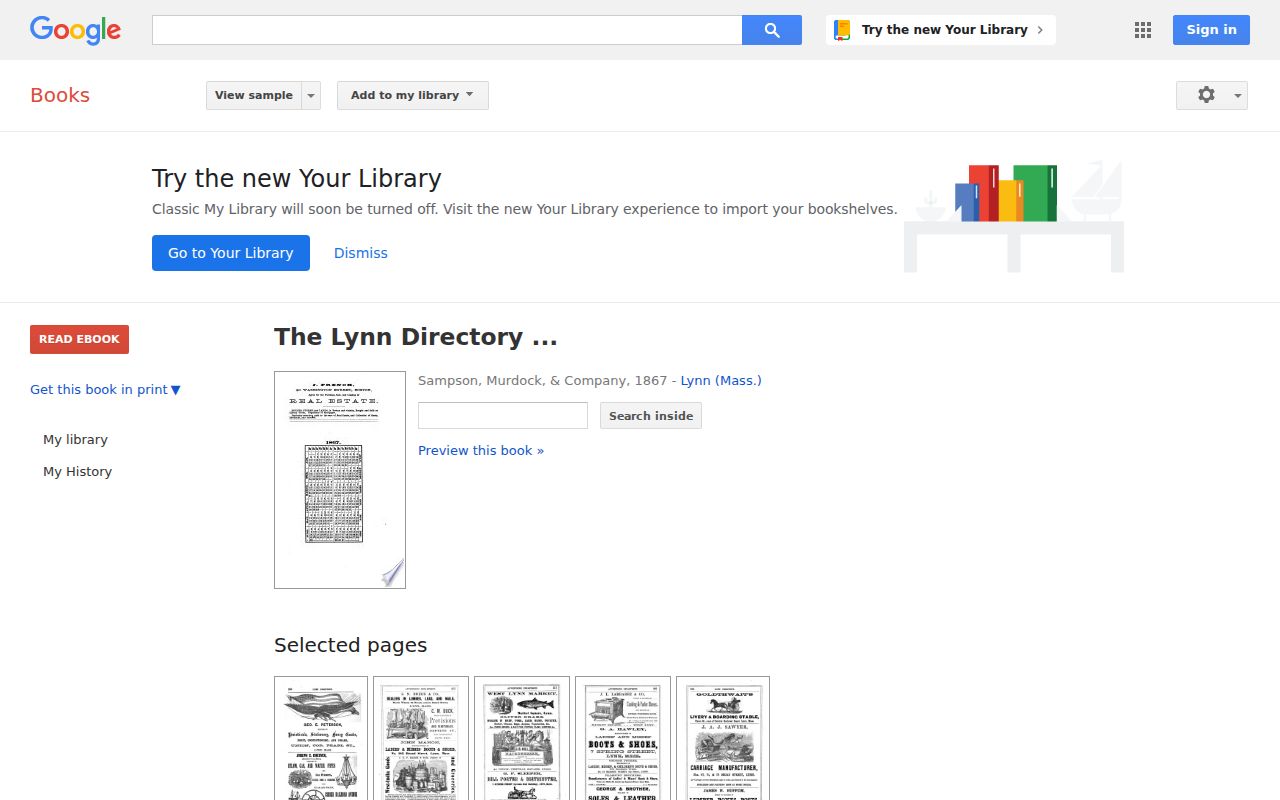
The 1867 image is a lead to a published page, not a verified family conclusion. Save the displayed page number and the publication year before connecting it to another source.
The 1887 Lynn Directory scan offers a later nineteenth-century view with historical address, street, spouse or widow, business, and office vocabulary. It is particularly helpful for studying how a surname, address, or street description appeared before the downtown fire. A year must remain attached to every transcription because two similar entries in different editions can represent different households or a move.
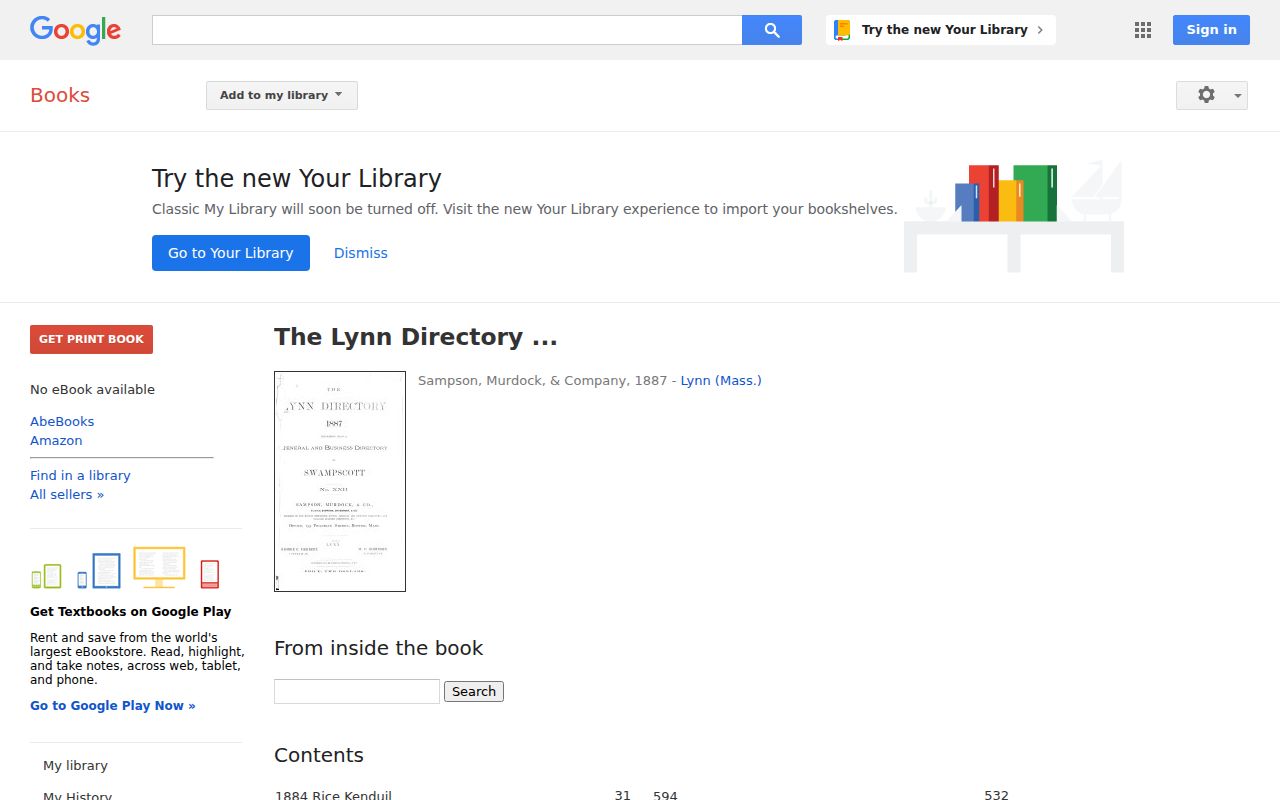
Use the image rather than an isolated search snippet when an abbreviation or number matters. It also makes it possible to compare adjacent listings and the original typographic marks.
Reading Lynn Directory Entries
A Lynn directory entry should be transcribed exactly before it is interpreted. The available 1887 scan shows the kinds of historical vocabulary that can appear beside a name: an address or street, a spouse or widow notation, a business or office reference, and a trade description. These are publication fields, not current facts. Compare the entry with its neighboring names and the volume's own abbreviation key before expanding a shortened word or joining it to another year.
| Name as printed | Preserve initials, punctuation, spelling, and any surname variation. |
|---|---|
| Street or address | Record the full string as printed, including an older street form or missing directional. |
| Household wording | Keep spouse, widow, or related notation exactly as the edition presents it. |
| Trade or business wording | Quote the historical label without turning it into a present-day claim. |
| Publication reference | Save the edition year, page, section, and a stable source link. |
- Criss-cross directory
- A directory arrangement by street or address rather than by surname, when the volume includes one.
- Householder index
- An index organized around the named household entry, useful for separating similar names in a publication.
- Abbreviation key
- The volume's own list of shortened labels. Read it before guessing what an entry means.
A directory's street-order material can be a useful historical address lead, but modern address-keyed sources are better handled through the Lynn street directory. The older volume supplies the dated published wording; it does not settle a current parcel or occupancy question.
Lynn Directories After 1889
The November 1889 Lynn fire is a critical context point for directory research. The city planning history reports that the fire began in Mower's Building on Almont Street, destroyed 31 downtown acres and 384 buildings, and displaced 150 households. That scale can interrupt address continuity and change the setting around a familiar street name. A missing or altered entry near that period is not, by itself, evidence that a person vanished from Lynn.
- Read an 1887 or 1888 directory page and preserve the street string exactly.
- Search the Daily Evening Item archive for the street, name, or fire-related event and save the page date.
- Use the 1893 Library of Congress Sanborn material as a building and block context source, not a resident list.
- Compare a 1890s directory entry with the earlier page, then test a recorded deed or legal description if the property identity matters.
This post-fire comparison is a local way to avoid forcing a modern address onto an older record. It also separates three dates that are often confused: the event date, the directory publication date, and the date a web scan was accessed.
Lynn Directory Change Clues
Consecutive Lynn volumes can suggest a move, a household change, or a spelling difference, but only when the evidence stays dated. The research file specifically identifies removed, widow, spouse, and changed-street wording as clues worth testing. They are not proof on their own. A same-name entry should be kept separate until an address, family connection, publication page, newspaper item, or formal record supports the connection.
Source test. A changed address is a published directory clue. Pair it with another dated source before calling it a move, a death, or a change in a household.
For the historical period, the Daily Evening Item archive covers 1877 through 1949 and has date and decade browsing. A newspaper result can add a contemporaneous page citation. The Lynn Museum may add family ephemera or institutional context through its research service. Each source has a different purpose, so keep the publication statement, reported event, and formal record in separate columns of a timeline.
Trace Lynn Households by Year
Family-history work benefits from a controlled year-by-year method. The State Library list has dense Lynn coverage in the 1880s through 1946, plus selected earlier and later volumes. Use that run to construct a sequence instead of jumping from one attractive result to a conclusion. Census schedules can then be paired with the directory years available for the relevant period, while a directory page can narrow the name and street form used in the census search.
- Choose the closest directory year and capture the full published entry with its page number.
- Check one earlier and one later Lynn volume for the same spelling and street form.
- Record each change as a dated observation, not as an unstated conclusion.
- Pair the sequence with an available census schedule, preserving its separate date and address wording.
- Use a newspaper, vital citation, deed, or museum request only to corroborate the specific transition being tested.
A modern record may be needed to test a current identity without turning an old directory listing into a current claim. When the research shifts from a historical printed name to one person in a current system, the Lynn resident lookup route uses different sources and privacy limits.
Lynn Directory Citation Rules
A usable directory citation needs more than a surname. Preserve the source title, publication year, page or image number, exact printed name, exact street string, and the link or custodian. If the page is an online scan, record the access date separately from the publication year. For a physical volume or microform copy, keep the library name and holding notation. These details make it possible to re-open the same evidence after a scan interface changes.
The research standard for a featured address or family finding is two independent sources, with one a record custodian or dated publication. A directory page plus a recorded instrument, a newspaper page plus a vital citation, or a map sheet plus a Registry document can form that bundle. If only one source is available, call it a lead. This keeps the historical Lynn volume useful without overstating what a printed listing can establish.
Lynn Directory Boundaries
Lynn's surviving records do not form a perfect chain. A digitized history reports that the oldest existing town record begins in 1691, while earlier material survives unevenly and some later records were damaged, transferred, or indexed in limited ways. Directory gaps, changed spellings, access restrictions, and scan availability can all explain a failed search. A missing result should be followed by a nearby year, a street variation, and a second official or archival custodian, not by a claim that no record exists.
Use historical directories for what they are best at: dated published names and addresses, local institutions, and a route into more exact sources. For a formal event, instrument, or certified record, follow the relevant Lynn, Essex County, or Massachusetts custodian process. Note: A directory scan can preserve a page that is useful for family history while still leaving its publication coverage and individual listing incomplete.